TradingKey - The latest monthly revenue data released by TSMC (TSM) once again shows that AI chip demand continues to drive growth in the global foundry market.
On September 10, TSMC reported its revenue for August 2026. Consolidated revenue for the month reached NT$514.86 billion, representing a year-over-year increase of 53.3% and a month-over-month growth of 10.1%, marking a record high for the fourth consecutive month. On a cumulative basis, the company's revenue for the first eight months of the year rose 39.3% year-over-year, demonstrating continued strong overall operational performance.
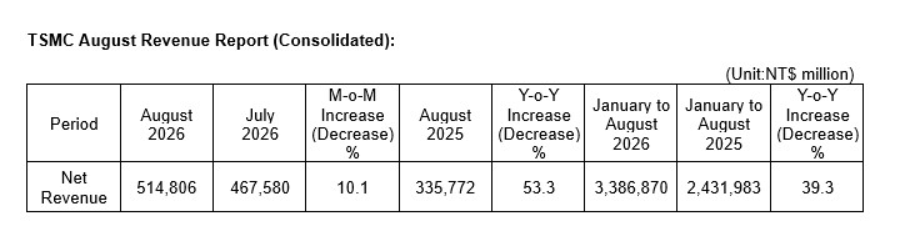
Source: TSMC
The continued growth in August revenue was mainly driven by demand for AI, high-performance computing, and advanced processes. As cloud service providers expand investments in AI data centers, orders for AI accelerators from companies like Nvidia (NVDA) and AMD (AMD), as well as proprietary ASICs from major cloud computing firms, have continued to increase. Consequently, TSMC's capacity utilization rates for advanced nodes and advanced packaging such as CoWoS have remained high. In addition, smartphone manufacturers entering their second-half new product stocking cycle brought additional demand for advanced nodes such as 3nm.
The growth rate of AI demand has even exceeded TSMC's previous expectations. Clifford Hou, Senior Vice President of TSMC, recently disclosed that late last year the company originally expected wafer demand to roughly double this year. However, it raised the forecast to a 1.25-fold increase in the first quarter of this year, and further upgraded it to a 1.9-fold increase in July. The continuous upward revision of demand expectations within just a few months indicates that AI infrastructure expansion is exerting a stronger pull on wafer manufacturing.
As orders continue to rise, TSMC is also accelerating its expansion. The company is currently constructing and configuring approximately 20 fabs simultaneously in Taiwan and overseas, a scale far higher than the four or five facilities pursued concurrently in the past.
Hou stated that even though the pace of fab expansion has accelerated significantly, the company still finds it difficult to fully meet current demand.
Meanwhile, TSMC will further increase its investment in advanced equipment and plans to adopt ASML's High NA EUV tools in mass production starting in 2030 to meet the manufacturing requirements of next-generation advanced nodes.
In addition to continued high demand for 3nm, 2nm is also emerging as a new growth driver. As high-performance computing and smartphone customers gradually adopt the N2 process, the revenue contribution from this segment is expected to continue rising.
The robust revenue performance also provides strong support for TSMC's full-year guidance. The company previously projected that its 2026 revenue in U.S. dollars would grow slightly above 40%, while raising its full-year capital expenditure target to between $60 billion and $64 billion. With cumulative revenue for the first eight months already posting rapid growth, combined with surging demand for AI chips, advanced packaging, and 2nm technology, market expectations for the company's full-year performance are likely to improve further.
Find out more